Tuesday, December 18, 2012

Cold Sauce with Christmas Pudding


Post by:           Rebecca Massie Lane
                        Director

"The Christmas Pudding"
English Traditional

Into the basin
put the plums,
Stir-about, stir-about,
stir-about!
Next the good
white flour comes,
Stir-about, stir-about,
stir about!
Sugar and peel
and eggs and spice,
Stir-about, stir-about,
stir-about!
Mix them and fix them
and cook them twice,
Stir-about, stir-about,
stir-about!


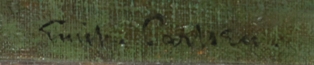
The artist, Frederick Stuart Church — often known in art as “the other Church” as to separate his identity from the more well-known Hudson River School painter — painted the holiday subject, “Cold Sauce with Christmas Pudding.”

 
Born in Grand Rapids, Mich., Church was directed by his parents toward a business career, and worked from age thirteen to 17 for the American Express Co. in Chicago. His interest in drawing was not encouraged by formal training at this time. When the Civil War broke out, he served for three years in the Union artillery, and then returned to Chicago where he studied at the Chicago Art Academy with artist Walter Shirlaw.

 
In 1870, he moved to New York and studied at the National Academy of Design with Lemuel Wilmarth and at the Art Students League. Early on, he earned his living as a commercial artist including illustrations for Harper's Weekly and later for Frank Leslie’s Weekly, Century Magazine, and Ladies’ Home Journal.

 
A successful New York illustrator at the height of the 19th century, Church’s work embodied the Victorian taste for the whimsical, for images of animals and fashionable young ladies, and for sentimental subjects.

 
Fanciful images of animals populated this work, and his interest in bears was particularly pronounced in his winter subjects such as the painting now on view at the Washington County Museum of Fine Arts. Titled “Cold Sauce with Christmas Pudding,” the painting captures the qualities of Victorian sentimentality.

 
Church often visited Barnum and Bailey's premises in New York City, as well as the Central Park Zoo, to study and make sketches of the animals held there. He also made painting expeditions to the countryside. In one period, he lived on a farm and taught the owner's two young daughters to draw. His patron, the banker Grant B. Schley eventually provided Church with a specially built studio at Schley's estate Froh Helm, located at Far Hills, N.J.

 
The museum’s  painting shows a fashionably dressed young woman, complete with elaborate bonnet, in conspiracy with a benign, jolly bear, making (and tasting) snow-icing for a Christmas pudding. The bear holds a bowl of sugary icing sauce, licking his paw, while the lady holds a spreading knife that also drips the sweet sauce. The pudding is the round bomb-shaped ball on the platter. A family of rabbits helps to support the great weight of the pudding on platter, the taller ones peeking over the edge in anticipation of the coming feast. In the left corner, two adolescent rabbits have snitched pieces of curled sugar cane, and two sparrows pick up the tasty nibbles that have dropped on the snow.

 
Though we get the general idea of this painting today, perhaps we can’t fully understand the Victorian enthusiasm for the subject because Christmas pudding has virtually disappeared from the menus of modern life.

 
What is a Christmas pudding? In Victorian England and America, it is a boiled dessert comprised of flour, sweet dried fruits, sometimes called “plum pudding”  that is cooked for hours. It dates back to medieval times, and until the 19th century, was cooked in a pudding cloth immersed in water. The Victorians developed a new pudding cooking technique, placing it in a basin and steaming it. It was reheated before serving, and iced with warm brandy, which was ignited as part of the dramatic presentation of the pudding.  After the brandy fire ebbed, the pudding would be served with a variety of possible sauces, including lemon cream, rum butter, custard, or sweetened béchamel.

 
To the Victorians, Church’s “cold sauce” enjoyed by the animals would have been the height of hilarity. The very idea of a bear assisting in its preparation and a lady dressed in finery icing the finished delicacy was a wonderful joke.

 
As an illustrator, he was often called upon to create appropriate holiday images for publication, including Halloween, Thanksgiving and Christmas. He illustrated the 1878 New World publication entitled “Out of this World”, portraying the human and animal protagonists of each of Aesop’s fables as well as the 1881 edition of “Uncle Remus, His Songs and His Sayings: The Folk-Lore of the Old Plantation,” by Joel Chandler Harris, published in New York by D. Appleton and Co.. He was a member of the National Academy of Design.

 
In the same year that he painted “Cold Sauce,” Church also created an etching for the Harper’s Weekly Children’s edition, referencing Christmas pudding.  This illustration was accompanied by John Kendrick Bangs’s  poem, “The Christmas Pudding.”

 
 Far, far away in a distant clime,
A Fairy small told me,
Over the frosty snow and rime
Is a rich plum-pudding tree;
A pudding-tree so large and fine,
That never a day doth pass
That dozens of puddings and pies divine
Don't fall on the soft green grass.

 
"Cold Sauce with Christmas Pudding" is on view now in the WCMFA's lobby. It was through the inventory process that the inventory team was able to easily select a work of art fitting for the holiday season.  


Tuesday, December 4, 2012

William Clutz, Artist


Post by: Jennifer Chapman Smith
              Collections and Exhibitions Manager
 
The inventory project is assisting the curatorial department in understanding the breadth and scope of the WCMFA’s collection. This is especially helpful when we examine the works of art in the collection by individual artists. We are fortunate to have fifteen works by the artist William Clutz in the museum’s permanent collection. It is significant to the WCMFA to have a variety of work by this artist since he credits the museum’s art school with beginning his artistic career.   
 
Thomas Danaher, "Portrait of William Clutz"
 
William Clutz was born in Gettysburg, Pennsylvania in 1933 and grew up in Mercersburg, Pennsylvania, about 30 minutes from the WCMFA. He attended Mercersburg Academy and attended the WCMFA’s art school in the late 1940s where he studied with Thomas Danaher, a WPA artist who received instruction from Hans Hoffman and Thomas Hart Benton. Clutz entered the annual Cumberland Valley Artists Exhibitions at the museum and won best of show in 1952, 1953, and 1957. Following graduation from the University of Iowa and study at the Art Students’ League, Clutz received numerous solo and group exhibitions throughout the United States and Europe. He is recognized as a significant proponent of abstract figuration in the renewed interest in figuration of the late 50’s and 60’s in such exhibitions as “Recent Drawings, USA”, 1956 and “Recent Paintings USA, the Figure,” 1962 at the Museum of Modern Art, New York, New York, and “The Emerging Figure”, Contemporary Arts Museum, Houston, Texas, 1960.
 
William Clutz, "Figures and Awning"
Clutz has approached his art from many different angles including abstraction, but his oil and pastel figural street scenes are his signature style. Inspiration for these compositions comes from the turbulent activity of the streets of New York City where Clutz lived. Children playing in the parks, cars zooming down the streets, passers-by flanked by skyscrapers, have all become subject matter for the artist. 
 
William Clutz, "August Spray"
His work is represented in major collections throughout the country, including the Metropolitan Museum of Art, the Guggenheim, and the Museum of Modern Art. Six of Clutz’s paintings in the WCMFA’s collection are currently on view in the Bowman Concert Gallery.
 
William Clutz, "Mother and Child Crossing"


Tuesday, November 20, 2012

Photographing the Collection


Blog post by:   Lauren Ippolito
                      Assistant Collections and Exhibitions Manager

Prior to the commencement of the WCMFA collections inventory project, object photographs were not consistent in size, format, or quality. Many objects in the museum’s collection did not have photographs in their object files, and an even larger number of objects lacked an image on the museum’s database. Every day of the inventory, we are taking several steps to eliminate this problem. In addition to taking a high quality digital image of each object, the inventory team uploads these images onto our PastPerfect database, and prints out an inventory form that includes a photo for each object file.

An object’s photograph is of value to the museum staff when responding to inquiries; preparing educational and interpretive programs and materials; facilitating outgoing loans to other institutions; and answering requests for reproductions for scholarly publications.

As we inventory each object, there are several detail photographs that we will take if they are present on an object. We note the artist’s signature, any makers’ mark, or hallmark on an object in the PastPerfect database and take a close-up photo. The painting below titled Moonlight by Emil Carlsen (American, 1853-1932) illustrates how it can be difficult to identify a signature in a photograph of the entire object.
 
 
The signature, as shown below, happens to be in the lower proper right corner of the painting.
 
 
If an object is framed, the inventory team photographs the object and its frame. The visual documentation of the frame assists staff when identifying objects, in planning and designing exhibitions, and for condition records. The inventory team also takes a photograph that we usually crop in order to have an image of only the object. The example below is Steer in Pasture by Henry Singlewood Bisbing (American, 1849-1933).


The inventory team photographs any labels or inscriptions on the frame. The following image shows the Lewis & Son Artistic Picture Frames’ label found on the back of a painting’s frame.
 
 
To supplement our condition reports of each object, the inventory team takes close-up photographs of specific condition issues. The photograph below shows a detail of a painting with crackled paint.
 
 
Every now and then, the inventory team finds something unique that we will photograph. For example, one of the WCMFA’s paintings by American artist, Charles Hugo Walther (1879-1938), Back Porch, 1928, has a still life sketch on the back of the canvas board that the painting is on.


Many of the images that we are uploading to the PastPerfect database will be available on our future online component of our PastPerfect database, which will allow the museum to share images of its collection with a larger audience than ever before.


Wednesday, November 14, 2012

Will Barnet (1911 - 2012)


Post by:           Jennifer Chapman Smith
                        Collections and Exhibitions Manager

The art world lost a great artist yesterday. Will Barnet passed away Tuesday, November 13, at the age of 101. Barnet had a long and varied career, continuing to paint 3 to 4 hours a day even at the end of his life when he could no longer stand. The New York Times remembers Barnet in the article below:
 
http://www.nytimes.com/2012/11/14/arts/design/will-barnet-painter-dies-at-101.html

The WCMFA is fortunate to have two works of art by Barnet in the collection, Factory District, Norwalk, Connecticut (1936, lithograph) and The Young Couple (1971, etching/aquatint). Both prints were donated to the museum by Spence and Cinda Perry.
 
Factory District, Norwalk, Connecticut, 1936, lithograph
 
 
The Young Couple, 1971, etching/aquatint
 
The works show the depth and breadth of Barnet’s art and especially highlights his strength as a printmaker. Though these works are not currently on view at the museum, because they were recently inventoried and photographed during the inventorying process we can share them with you here so you can enjoy the wonderful art of this artist who will be greatly missed.
 
 
You have to believe in what you're doing. In the long run, you have to feel that what
you're doing, regardless of the trends, will have a lasting quality.
Someday someone may pick it up and recognize that it was superior.
 – Will Barnet


Tuesday, November 13, 2012

Happy Birthday Rodin!


Post by:           Jennifer Chapman Smith
                        Collections and Exhibitions Manager
 
Yesterday, November 12, was Auguste Rodin’s birthday. Maybe you saw the Google Doodle yesterday – if not here is a link to an article with a picture of it

http://www.latimes.com/entertainment/arts/culture/la-et-cm-auguste-rodin-google-camille-claudel-20121112,0,3763540.story
 
The WCMFA is especially privileged to have a variety of sculptures by Rodin in the permanent collection. Many of these sculptures were given to the museum by our founders William Henry and Anna Brugh Singer, Jr. who admired Rodin’s work. One of the WCMFA’s Rodin sculptures is St. John the Baptist, a bronze done in 1878, and currently on view in the museum’s Schreiber Gallery.


This sculpture clearly shows Rodin’s devotion to the naturalism of the human body. As Dr. Elizabeth Johns writes in “One Hundred Stories: Highlights from the Washington County Museum of Fine Arts,” [r]ejecting the idealizing Neoclassicism of academic sculpture that was the standard when he began his studies, he insisted on fidelity to human anatomy and evocation of the emotions of his subjects. He hired ordinary people from the street to be his models, creating his sculptures in clay or plaster. These media could show the firmness of bone, the ripple of muscles, the shadows of body contours. Cast in bronze, the sculptures provide the almost contradictory pleasures of seeing a naturalistic representation in a hard medium.”

Rodin was inspired by the work of Michelangelo and Donatello and brought this inspiration to the creation of St. John the Baptist. The WCMFA’s piece is a casting from a smaller study for a larger work standing 6 feet 5 inches – the WCMFA’s version is 31 inches high.
 
Rodin’s larger St. John the Baptist is still not as tall as the WCMFA’s iconic Diana of the Chase by Anna Hyatt Huntington, which stands about 8 feet tall.

Unveiling of Diana of the Chase in the WCMFA's Rotunda, 1942

 
 So let's all sing Happy Birthday, or more appropriately Bon Anniversaire, to this great artist!


Thursday, November 8, 2012

The Quality Instinct

Post by: Mary Case, Inventory Consultant
             Organizational Coach, Qm2: Quality Management to a
             Higher Power
 
One resource that presented itself this year was Max Anderson’s The Quality Instinct.  Mr. Anderson, a highly regarded museum professional, currently Director, Dallas Museum of Art, invites every reader to understand the deepest questions art historians ask of themselves-- what is quality -- in art, in all manmade things -- packaging design, automobiles, kitchen tools, a good suit.  He writes as a memoirist, reminiscing about objects he has unearthed from the storerooms of the Metropolitan Museum of Art or found in obscure Italian churches.


Rebecca Massie Lane, Director, and Dr. Elizabeth Johns, Co-Chair, Collections and Exhibitions Committee, reviewed Anderson’s book together and Beth led a discussion with the committee.  The Inventory Team presented pairs of accessioned objects for discussion:  those of high quality along side something not as stellar.  2 portraits, for example.  Folk carvings.  There ensued lively revelations and insights for the museum’s leadership, insights which will play out in museum policy and, ultimately, in the lives of visitors to the museum


For a video of Mr. Anderson on The Quality Instinct

Thursday, October 25, 2012

A Consultant on the Team


Post by: Mary Case, Inventory Consultant
              Organizational Coach, Qm2:  Quality Management to a
              Higher Power
     

Joining the WCMFA Collections Inventory Project, afforded me the privileged opportunity that a skilled outsider always receives when offered a temporary spot on a functioning team.  This team -- Jennifer Chapman Smith, Lauren Ippolito, and Linda Dodson -- and joined later by Kay Palmateer  -- managed to uncover and address with energy and curiosity every challenge of a museum collections inventory. 

First, the collections areas needed to be outfitted for the work.  Out with the old boxes, periodicals, unusable castoffs, and accumulations that occur in shared workspaces over decades. Yes, they did unearth a desiccated snake way back in the corner.  Yikes!
 
Careful with the measurements and allocations of potential spaces for specific work and specific collections to be moved into freshly organized spaces.   More care lavished on cleaning floors, walls, crevices, pipes. Every space, cabinet, and shelf were freshly numbered and labeled. Hygrothermographs ready.
Museum collections have two parts:  the object and the information about it.  So, from the start, the team thought deeply about how to migrate information from an inadequate legacy computer program and how to integrate the standing files.  A skilled volunteer – Judy Wheeler  -- scrubbed the data and we were launched into the world of PastPerfect.
What is the role of a consultant in this sort of exercise?  Listening carefully and asking questions.  Sometimes more than once.  Connecting staff and volunteers with resources.  Present different ways of thinking about things, from the sidelines.  Watching as the work proceeded, in spite of all the normal and unusual distractions of life and the nonprofit workplace. Coaching.
 
When asked what they felt what my role in the inventory process is and how I have assisted in the process, Jennifer and Lauren responded:
Mary Case brings a deep understanding of museum practices and procedures as well as a perceptive insight into people and teams. All of this knowledge combined has made Mary an invaluable resource for the WCMFA’s collection inventory project. As a consultant she brings with her a fresh perspective and new ideas. She is especially good at facilitating discussions and asking the questions that create deeper thinking about the WCMFA’s collection and how we use it to enrich our visitors’ experience.